
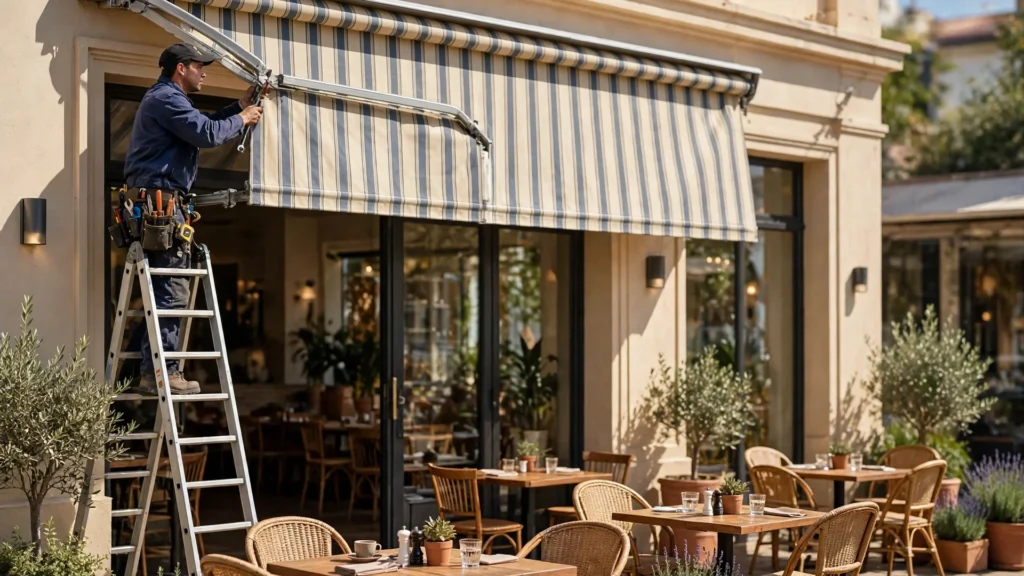
Most awning company websites look like digital brochures from 2012. A few stock photos of striped fabric, a phone number buried in the footer, and a contact form nobody fills out. Meanwhile the homeowner who just spent twenty minutes comparing retractable and fixed awnings on your competitor’s site is already booking a free consultation with them. Not because their awnings are better. Because their website made the decision easy.
Awning buyers are visual, project-driven shoppers. They are not buying a commodity. They are imagining what their patio, storefront, or restaurant deck will look like in July when the afternoon sun hits it. A website that sells awnings has to sell that vision first and the product second. This guide breaks down exactly what web design for awning companies needs to include, the mistakes that quietly cost installers real jobs, and how to tell whether your current site is helping or hurting.
Why Awning Buyers Shop Differently Than Other Home Service Customers
A homeowner calling a plumber has an emergency and a short decision cycle. A homeowner shopping for an awning has a project and a long one. Understanding that difference is the foundation of every design choice that follows.
They buy with their eyes. Nobody picks an awning from a spec sheet. They pick it from photos of other people’s homes and businesses. Fabric color, valance style, how the frame sits against the siding, what the shade pattern looks like at 3 PM. If your website does not show real installations in rich detail, you are asking visitors to imagine the most important part. Most will not bother. They will bounce to the installer whose gallery answers the question for them.
They compare before they call. Retractable versus fixed. Lateral arm versus drop arm versus dome. Acrylic versus vinyl-coated polyester. Metal awnings versus fabric. Awning shoppers research these tradeoffs for days before they ever pick up the phone. A website that hosts that comparison, honestly and in plain language, becomes the trusted advisor. The company that educates wins the consultation more often than the company with the lowest price.
They worry about permission, not just price. A surprising number of awning projects stall on HOA approvals, historic district rules, or commercial signage codes. Buyers in planned communities and business owners in regulated districts carry real anxiety about this. A website that addresses compliance head-on, with a dedicated section explaining how you handle HOA submissions and permit paperwork, removes a silent objection that kills conversions.
They are spending real money on something permanent. A quality retractable awning installed runs into the thousands. This is not an impulse buy. Buyers want proof of craftsmanship, longevity, and a company that will still be around when the fabric needs replacing in eight years. Your website has to carry that weight of trust.
The Anatomy of a High-Converting Awning Company Website
A site built to book consultations is engineered around one job: moving a visitor from curiosity to a scheduled estimate. Every element below serves that job.
1. Project Galleries Organized the Way Buyers Think
A single “Gallery” page with 40 unsorted photos is nearly useless. Buyers think in categories: residential patios, restaurant decks, storefronts, windows and doors, retractable systems, fixed metal awnings. Organize galleries by project type and by awning style so a visitor finds their exact situation in two clicks. Each gallery entry should show multiple angles, name the fabric and frame system used, and note the project location. Real project details turn pretty pictures into proof.
2. Fabric and Material Guides That Replace the Showroom Visit
The fabric decision is where most awning sales are won or lost. Dedicate real pages to your fabric lines: solution-dyed acrylics, vinyl laminates, mesh solar screens. Show large color swatches photographed in natural light, not manufacturer renders. Explain fade resistance, water resistance, and warranty in plain terms. A buyer who has already narrowed their fabric choice on your website arrives at the consultation halfway sold.
3. A Retractable vs. Fixed Comparison Page
This single page will become one of your highest-traffic assets. Homeowners search this comparison constantly, and most installer sites either skip it or bury it in a blog post. Build it as a proper guide: cost ranges, lifespan, wind resistance, maintenance, best use cases for each. End it with a simple recommendation framework and a consultation CTA. Pages like this do double duty. They rank in search and they pre-sell.
4. Service Area Pages With Local Proof
Awning installation is local work, and search engines treat it that way. Build dedicated pages for each city and neighborhood you serve, each with local project photos, local reviews, and notes on local considerations like HOA prevalence or sun exposure patterns. Generic “we serve the greater metro area” copy converts nobody. Specificity converts. This is the same local-first approach behind effective SEO for home services, where service-area depth separates the companies that rank from the ones that do not.
5. A Quote Flow Built for How People Actually Decide
The standard “contact us” form with name, email, phone, and message is a conversion killer for project buyers. They do not know what to write. Replace it with a guided quote flow: project type, approximate size, retractable or fixed preference, timeline, photos of the space optional. Each step feels like progress, and by the end the visitor has mentally committed to the project. Keep the phone number visible on every screen too. Plenty of buyers, especially commercial ones, will always prefer to call.
6. Trust Signals Placed Where Doubt Appears
Do not confine reviews and credentials to an “About” page nobody reads. Place review snippets next to pricing guidance, warranty badges next to fabric pages, and installer certifications next to the booking form. Trust signals work when they answer the objection forming in the visitor’s mind at that exact moment.
7. Mobile Speed That Matches the Buying Moment
A large share of awning research happens on phones, often while the homeowner is standing on the patio looking at the sun problem. If your gallery takes six seconds to load on mobile data, that sale is gone. Compress images properly, lazy-load below the fold, and test the quote flow on a mid-range phone, not just the office desktop. Speed is a design feature, not a technical afterthought.
The 7 Pages Every Awning Company Website Needs
If you are rebuilding or auditing your site, make sure these pages exist and earn their keep:
- Homepage that states what you install, where, and for whom within five seconds, with one clear consultation CTA.
- Residential awnings page with patio, deck, window, and door subsections.
- Commercial awnings page covering storefronts, restaurants, and branding options like graphics on valances.
- Retractable awnings product page with motorization and sensor options explained.
- Fabric and materials guide with real photography and warranty details.
- Service area pages, one per market, with local projects and reviews.
- About and reviews that show the actual installation crew, not stock handshakes.
Most awning sites we audit are missing at least three of these. Each missing page is a search query you cannot rank for and a buyer question you cannot answer.
5 Mistakes That Quietly Cost Awning Companies Jobs
Mistake 1: Stock photography. Nothing erodes trust faster than the same striped-awning stock photo appearing on twelve installer websites. Buyers notice. Invest in photographing your own installs. Even a phone camera on a sunny day beats a stock library.
Mistake 2: Hiding all pricing signals. You do not need to publish fixed prices, and for custom work you should not. But “call for a quote” with zero guidance scares off early-stage researchers. Publish honest ranges: what a typical window awning runs, what a motorized retractable patio system runs, what drives the price up or down. Ranges qualify leads and build trust at the same time.
Mistake 3: No commercial presence. Many awning companies do strong restaurant and retail work but show only residential photos. Commercial buyers have bigger tickets and different concerns: branding on fabric, nighttime lighting integration, code compliance. If you want that work, dedicate pages to it.
Mistake 4: Burying the service area. If a visitor cannot tell in ten seconds whether you serve their town, they leave. Put service areas in the header or hero, not three clicks deep.
Mistake 5: Treating the website as finished. Google rewards freshness, and buyers notice stale content. Add recent projects monthly, update fabric lines when manufacturers change them, and keep reviews current. A site whose newest gallery photo is from 2021 tells visitors the business might be too.
Agency vs. Templates vs. Gig Marketplaces
Awning company owners generally face three options, and the tradeoffs matter more in this niche than in most.
DIY website builders get you online fast and cheap, but they fight you on exactly the things awning sites need most: organized multi-gallery structures, guided quote flows, and fast image-heavy pages. You end up with a generic site that looks like every other small business template.
Gig marketplaces can produce something decent if you manage the freelancer tightly, but the typical gig seller has never thought about HOA objection handling or retractable-versus-fixed buyer psychology. You get pixels, not strategy. And when the freelancer moves on, nobody maintains the site.
A dedicated agency that understands contractor marketing builds the strategy into the design: the page architecture follows the buyer’s research journey, the quote flow matches how project sales actually close, and the site is maintained as a living asset. That is the model behind our web design for contractors work, where trade-specific buyer behavior shapes every layout decision instead of being an afterthought.
The honest math: a single commercial awning project can be worth five figures. If a properly built website brings you even two or three extra projects a year that a template site would have lost, it has paid for itself many times over.
What Good Web Design Costs for an Awning Company
Pricing varies, but here is a realistic frame. A solid custom site for an awning installer, with organized galleries, a guided quote flow, service area pages, and local SEO foundations, typically lands in the mid four figures to low five figures depending on scope and content needs. Ongoing care, content additions, and SEO usually run a few hundred a month.
Beware of two extremes. The $500 site will cost you far more in lost jobs than it saves. The $40,000 agency engagement built for national brands will load your small installer site with features you will never use. The right investment matches the ticket size of your average project and the competitiveness of your local market.
Why Awning Companies Choose DG Equinox
DG Equinox builds websites for contractors and home service businesses that are designed around how their buyers actually decide. For awning companies that means project galleries organized by buyer intent, fabric guides that pre-sell consultations, comparison content that captures research traffic, and quote flows engineered for project sales. Every site ships with local SEO foundations, review integration, and the speed standards mobile buyers expect, backed by branding that makes a local installer look like the obvious choice. If your current website is a brochure, we will turn it into a salesperson. Start with a look at our web design company approach or browse recent thinking on our blog, then reach out for a consultation built around your market.
Frequently Asked Questions
How much does web design cost for an awning company?
A professional custom website for an awning installer typically costs in the mid four figures to low five figures, depending on the number of service area pages, gallery organization, and whether you need content written for fabric guides and comparison pages. Template-based builds cost less upfront but rarely include the buyer-journey structure that makes awning sites convert. Measure the investment against your average project ticket: one or two extra commercial jobs a year usually covers it.
What pages should an awning company website have?
At minimum: a homepage with a clear consultation CTA, residential and commercial awning pages, a retractable awnings product page, a fabric and materials guide, service area pages for each market you serve, and an about/reviews page showing your real crew. The highest-converting addition most installers lack is a retractable-versus-fixed comparison guide, which captures research-stage traffic and pre-sells consultations.
Do awning companies need local SEO or just a good website?
Both, and they reinforce each other. A good website converts the traffic, but local SEO is what brings the traffic: Google Business Profile optimization, service area pages, local reviews, and local citations. Many awning installers compete in markets where the top three map-pack spots take most calls, so a beautiful site without local visibility is an expensive brochure. Build them together.
How long does it take to build a website for an awning company?
A focused custom build typically takes four to eight weeks from kickoff to launch, depending on how quickly photography, fabric details, and content approvals come together. The longest delays almost always come from the client’s side: gathering project photos and approving copy. Companies that arrive with organized photos and clear service descriptions launch fastest.
Should we show pricing on our awning website?
Show ranges, not fixed quotes. Publishing honest cost ranges for typical projects (window awnings, patio retractables, commercial storefronts) builds trust and qualifies leads before they call. It also filters out price shoppers who were never going to buy at your level, saving your sales team time. Keep the ranges updated as material costs change.
Can a new website actually bring in more awning consultations?
Yes, when it is built around the awning buyer’s decision process rather than generic small-business templates. The levers are specific: organized project galleries, a guided quote flow instead of a blank contact form, comparison content that captures research traffic, visible service areas, and mobile speed. Installers who upgrade from brochure sites to buyer-journey sites consistently report more and better-qualified consultation requests.